
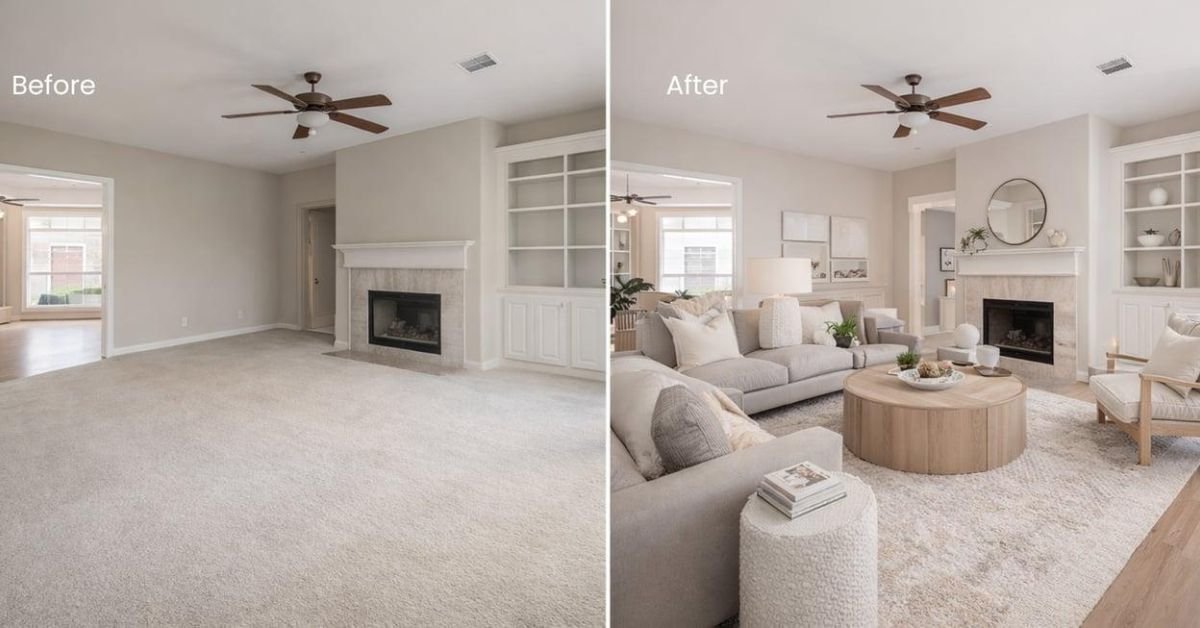
Can Virtual Staging Help Sell an Empty House Faster?
Yes, virtual staging can help you market an empty house more effectively and potentially attract buyer interest sooner. However, it does not guarantee a faster sale. Your results depend on the property’s location, price, condition, photography, marketing strategy, and buyer demand.
Think about the experience of shopping for furniture in a completely empty room. You can see the walls and floor, but imagining the finished space takes effort. Now picture that same room with a properly sized sofa, a coffee table, warm lighting, and tasteful artwork. Suddenly, the room feels easier to understand.
That is the main purpose of virtual staging.
Using digital furniture and décor, you can transform photographs of vacant rooms into attractive, realistic marketing images—without physically bringing furniture into the property.
If you are a realtor, home seller, or property marketer, virtual staging can help you show buyers what an empty house could become while keeping your marketing process flexible and affordable.
Why Is Selling an Empty House Often Challenging?
An empty property may look clean and spacious in person, but vacant rooms can create problems in online listings.
Most buyers begin their search by viewing photographs. If those photographs show bare walls, empty floors, and rooms without a clear purpose, buyers may struggle to connect emotionally with the property.
1. Empty Rooms Can Be Difficult to Visualize
Not every buyer can easily imagine how furniture will fit into a room.
For example, suppose a living room measures approximately 12 feet by 15 feet. Without furniture, the space may appear unusually large or oddly shaped. A buyer might not know whether it can accommodate a sectional sofa, two chairs, a television, and a coffee table.
Virtual staging provides a visual reference.
A digitally staged image can show how the room might function while helping buyers understand its proportions and layout.
2. Vacant Photos May Feel Cold or Uninviting
An empty house can lack the warmth that helps buyers imagine themselves living there.
A vacant bedroom may show a window, flooring, and four walls, but a staged image can demonstrate how a queen-size bed, two nightstands, a dresser, and soft lighting might work together.
The goal is not to disguise the room. It is to give the room a clear story.
3. Buyers May Misjudge Room Size
Furniture helps people judge scale.
A small sofa can make a large room look more spacious, while oversized furniture can make a compact room appear cramped. Professional virtual staging should use furniture that matches the room’s dimensions and perspective.
When the scale is wrong, the image may look artificial—and buyers may lose confidence in the listing.

What Is Virtual Staging for Vacant Homes?
Virtual staging is the process of adding digital furniture, decorations, lighting enhancements, and other non-architectural elements to a real estate photograph.
Instead of renting physical furniture and arranging it inside the property, you use specialized software or artificial intelligence to create a staged version of the original image.
A typical workflow looks like this:
-
You photograph the empty room.
-
You select a design style, such as modern, Scandinavian, traditional, or contemporary.
-
A virtual staging tool adds appropriately scaled furniture and décor.
-
You review the image for realism and accuracy.
-
You use the approved image in your marketing campaign.
A good virtual staging process should preserve the original architecture. Doors, windows, walls, flooring, stairs, room dimensions, and other important structural features should remain unchanged.
Which Rooms Should You Stage First?
You do not necessarily need to stage every room.
Start with spaces that influence a buyer’s understanding of the home, such as:
-
Living room
-
Primary bedroom
-
Dining room
-
Kitchen
-
Basement family room
-
Home office
If your budget is limited, focus on the living room and primary bedroom first. These rooms often help buyers understand the property’s lifestyle and functionality.
Can Virtual Staging Help Sell an Empty House Faster?
Virtual staging may help support a faster sale by improving how buyers experience your listing online. It does this through several important marketing advantages.
Better Listing Photos Can Increase Buyer Interest
Your listing photos are often the first impression a buyer receives.
Imagine scrolling through 30 property listings. One shows an empty room with harsh lighting and no furniture. Another shows the same room with tasteful furnishings, clear walkways, and a welcoming layout.
Which image makes it easier to imagine living there?
Virtual staging can make your listing more visually engaging. It may encourage buyers to spend more time reviewing the property, share the listing, or arrange a viewing.
However, attractive images alone cannot overcome an unrealistic asking price, serious property defects, or weak demand in the local market.
Virtual Staging Can Improve the Overall Listing Presentation
A vacant property can sometimes look unfinished in marketing materials, even when the home itself is in excellent condition.
Staged images create a more complete presentation. They help you show the potential use of each room and create visual consistency across the listing.
For example, you might use:
-
A contemporary living room
-
A calm, minimalist primary bedroom
-
A functional home office
-
A warm dining area
The design should feel coordinated rather than random. A consistent visual style can make your listing appear more professionally prepared.
Other Factors Still Influence the Speed of a Sale
Virtual staging is only one part of the selling process.
The following factors also matter:
-
Accurate pricing
-
Property condition
-
Location and neighborhood demand
-
Quality of the listing description
-
Professional photography
-
Online exposure
-
Showing availability
-
Negotiation strategy
Think of virtual staging as the packaging around your marketing message. Strong packaging helps attract attention, but the product itself still needs to meet buyer expectations.
How Virtual Staging Helps Buyers Visualize an Empty Property
A well-staged image can answer questions that an empty photograph leaves unanswered.
Show How Buyers Could Use Each Room
An empty room may have several possible purposes. Virtual staging lets you demonstrate one practical option.
For example, a spare bedroom could be presented as:
-
A guest bedroom
-
A home office
-
A child’s bedroom
-
A reading room
You should avoid presenting an unrealistic number of uses in the same image. Choose a design that fits the room and the likely needs of the target buyer.
Demonstrate Furniture Scale and Placement
Furniture placement can help buyers understand circulation and available space.
A staged living room should show enough room to walk between the sofa, coffee table, doorway, and other key areas. Furniture should not block windows, doors, vents, or architectural features.
If a room is approximately 10 feet wide, placing a huge sectional across the entire space may make the layout look impractical. Choose furniture that leaves comfortable pathways and reflects the room’s actual proportions.
Help Buyers Imagine a Lifestyle
People do not simply buy square footage. They often imagine routines, comfort, convenience, and lifestyle.
A staged dining room might suggest family meals. A home office might show how someone could work remotely. A furnished patio might help buyers picture outdoor entertaining.
These visual cues can make the property easier to understand without making promises about how buyers will use the space.

Key Benefits of Virtual Staging for Vacant Properties
1. Improve Your Online Listing
Virtual staging can give your property photographs a more polished appearance. You can use staged images on real estate websites, social media, email campaigns, and digital advertisements.
2. Market the Property Before Physical Furnishing
If the property is vacant, you do not have to wait for furniture delivery, installation, or physical staging arrangements.
You can prepare marketing images soon after obtaining suitable property photographs. This can be useful when you need to promote a new listing quickly.
3. Present Different Design Styles
One empty room can be shown in several design directions.
For example, you might create:
-
Modern luxury
-
Scandinavian
-
Contemporary
-
Traditional
-
Japandi
-
Coastal
Use this flexibility carefully. Too many design variations may confuse buyers. Select a style that suits the property’s architecture, price range, and likely audience.
4. Reduce Physical Staging Requirements
Physical staging involves furniture rental, transportation, setup, removal, and sometimes storage. Virtual staging avoids many of these logistical requirements.
It can be particularly useful for properties that are:
-
Located far from your staging company
-
Listed for a short period
-
Difficult to access
-
Awaiting renovation
-
Being marketed to buyers in different locations
Virtual staging does not eliminate every marketing expense, but it can offer a practical alternative to furnishing an entire vacant home.
Virtual Staging vs. Physical Staging: Which Should You Use?
Both methods have advantages, and the right choice depends on your property and marketing goals.
Advantages of Virtual Staging
Virtual staging can offer:
-
Faster image preparation
-
Flexible design options
-
Lower logistical demands
-
Easy furniture style changes
-
Useful marketing visuals for vacant rooms
It works especially well when your main objective is to improve online photographs.
Advantages of Physical Staging
Physical staging allows buyers to see and experience real furniture during an in-person showing.
It can help buyers understand room scale, movement, comfort, and the physical relationship between furniture and the space.
Physical staging may be useful when the property is high-end, difficult to visualize, or likely to receive many in-person visits.
Consider a Hybrid Approach
You do not always have to choose only one method.
For example, you could use virtual staging for online marketing and physically stage the living room before an important open house. This approach allows you to combine digital presentation with an in-person experience.
How to Use Virtual Staging in Your Empty-Home Marketing
Use Staged Images Alongside Original Photos
Transparency matters.
Consider showing both the original photograph and the virtually staged version. This approach helps buyers understand which elements are digitally added.
It also reduces the risk of creating unrealistic expectations.
Create Before-and-After Social Media Content
Before-and-after images can work well on platforms such as Instagram, Facebook, Pinterest, and LinkedIn.
You might create a simple post showing:
-
Original empty room
-
Virtually staged room
-
Short explanation of the design choices
-
Call to action to view the property
Make sure the staged image does not imply that the furniture physically exists inside the home.
Use Virtual Staging in Digital Advertising
A staged image can be useful in paid advertising campaigns, email marketing, and property showcase videos.
Test different visuals and track meaningful results, such as:
-
Click-through rate
-
Listing page visits
-
Inquiry volume
-
Showing requests
-
Time spent on the listing page
Do not judge the campaign only by likes or views. Your goal is to attract qualified buyers and encourage the next step.

Important Limitations You Should Understand
Virtual staging can improve presentation, but it cannot solve every problem.
Virtual Staging Cannot Repair Property Defects
Digital furniture cannot fix:
-
Water damage
-
Cracked walls
-
Poor flooring
-
Structural problems
-
Outdated mechanical systems
-
Inadequate natural light
You may be able to digitally enhance certain visual elements, but you should not misrepresent the actual condition of the property.
It Cannot Replace an In-Person Viewing
Photographs provide only part of the buyer experience.
Buyers still need to evaluate the property’s actual condition, room dimensions, noise levels, neighborhood, finishes, and other physical characteristics.
You Must Preserve the Original Architecture
Do not allow virtual staging to change the floor plan or misrepresent the home.
The following elements should remain accurate:
-
Door and window locations
-
Wall positions
-
Staircases
-
Room sizes
-
Kitchen cabinets
-
Walkways
-
Architectural openings
Also, clearly identify digitally staged images according to applicable real estate rules, platform policies, and professional standards.
Common Virtual Staging Mistakes to Avoid
Even a well-designed concept can fail if the execution looks unrealistic.
Avoid these common mistakes:
-
Using furniture that is too large or too small.
-
Blocking doors, windows, or walkways.
-
Adding too many decorative items.
-
Using a style that conflicts with the property.
-
Changing architectural features.
-
Making every room look identical.
-
Failing to label digitally staged images.
A staged image should look like a believable version of the actual room—not a fantasy renovation.
Seven Actionable Tips for Better Virtual Staging Results
1. Start With High-Quality Photography
Use sharp, well-lit photographs with straight vertical lines. Poor source images can limit the quality of the final result.
2. Stage the Most Important Rooms First
If you can stage only two rooms, consider the living room and primary bedroom. Choose rooms that help buyers understand the home’s main selling points.
3. Match the Style to the Property
A traditional home may benefit from classic or transitional furniture. A modern condominium may suit contemporary or minimalist décor.
4. Prioritize Realistic Furniture Proportions
Use the room’s approximate measurements to guide furniture selection. Leave practical walking space around major furnishings.
5. Preserve the Original Layout
Review every image carefully. Check that doors, windows, stairs, cabinets, and walkways remain in their original positions.
6. Show Original and Staged Versions
Use clear labels and avoid giving buyers the impression that the furniture is physically present.
7. Measure Marketing Performance
Compare listing engagement, inquiries, and showing requests before and after improving your property images. Where possible, use consistent time periods and similar marketing conditions.
How Do You Decide Whether Virtual Staging Is Worth It?
Ask yourself five questions:
-
Is the property completely vacant?
-
Are the rooms difficult to visualize?
-
Do you need marketing images quickly?
-
Would physical staging create significant logistical costs?
-
Does your target audience respond strongly to visual presentation?
If the answers point toward a need for stronger listing images, virtual staging may be worth considering.
You should also evaluate the property’s condition. If buyers need to see significant repairs or unfinished work, make sure your marketing communicates the actual state of the home clearly.
Conclusion: Turn Empty Rooms Into Clear Possibilities
Can virtual staging help sell an empty house faster? It can help you present the property more effectively, attract attention online, and give buyers a clearer idea of how each room might function. However, it works best as part of a complete marketing strategy—not as a substitute for accurate pricing, honest representation, quality photography, and strong buyer communication.
An empty house does not have to look like an empty opportunity.
With realistic furniture, thoughtful design, correct proportions, and transparent marketing, you can help buyers see beyond bare walls and imagine the possibilities. Use virtual staging to make your listing easier to understand, more engaging to explore, and more memorable when buyers compare properties.
Your goal is simple: show the home clearly, build buyer confidence, and make every marketing image work harder for you.
Frequently Asked Questions
1. Does virtual staging guarantee that an empty house will sell faster?
No. Virtual staging can improve the visual presentation of a property, but it cannot guarantee a faster sale. Pricing, location, condition, buyer demand, and marketing reach also influence how quickly a home sells.
2. Is virtual staging effective for a completely vacant property?
Yes. Virtual staging can be especially useful for vacant homes because it helps buyers visualize furniture placement, room function, and interior design possibilities without requiring physical furniture.
3. Should you disclose that a photo has been virtually staged?
You should clearly identify digitally staged images and follow applicable real estate regulations, platform requirements, and professional standards. Buyers should understand which elements appear digitally and which are physically present.
4. How many rooms should you virtually stage?
There is no universal number. If your budget is limited, begin with one or two important spaces, such as the living room and primary bedroom. You can expand to additional rooms based on the property’s layout and marketing needs.
5. Is virtual staging better than traditional physical staging?
Neither option is suitable for every property. Virtual staging can be useful for online presentation and flexibility, while physical staging allows buyers to experience real furniture during showings. A hybrid strategy may work well for some properties.